


 B Home Glossary D
Revised May 27 2021
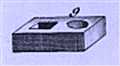 F: a strong, thick block of wood, used to confine two
masts together, when the one is erected at the head
of the other, in order to lengthen it. It is for this purpose furnished with two holes perpendicular to its length
and breadth, and parallel to its thickness; one of these is square, and the other round; the former being solidly
fixed upon the upper end of the lower mast, whilst the latter receives the mast employed to lengthen it, and
secures it in this position. The principal caps of a ship are those of the lower masts, which are fitted with a
strong eye bolt on each side, wherein to hook the block by which the
topmast is drawn up through the cap.
The breadth of all caps is equal to twice the diameter of the topmast, and the length to twice the breadth.
The thickness of the main and forecaps is half the diameter of their breadths; the
mizen cap three-sevenths,
and the topmast caps two-fifths of their respective breadths.
In the same manner as the topmast slides up through the cap of the lower mast, the
topgallant mast slides up through the cap of the topmast.
F: a strong, thick block of wood, used to confine two
masts together, when the one is erected at the head
of the other, in order to lengthen it. It is for this purpose furnished with two holes perpendicular to its length
and breadth, and parallel to its thickness; one of these is square, and the other round; the former being solidly
fixed upon the upper end of the lower mast, whilst the latter receives the mast employed to lengthen it, and
secures it in this position. The principal caps of a ship are those of the lower masts, which are fitted with a
strong eye bolt on each side, wherein to hook the block by which the
topmast is drawn up through the cap.
The breadth of all caps is equal to twice the diameter of the topmast, and the length to twice the breadth.
The thickness of the main and forecaps is half the diameter of their breadths; the
mizen cap three-sevenths,
and the topmast caps two-fifths of their respective breadths.
In the same manner as the topmast slides up through the cap of the lower mast, the
topgallant mast slides up through the cap of the topmast.
 WP: a method of constructing wooden boats and tall ships by fixing planks to a frame so that the
planks butt up against each other, edge to edge, gaining support from the frame and forming a smooth hull.
Such planking requires caulking between the joints over and above that needed by the clinker built technology,
but gives a stronger hull capable of taking a variety of
full-rigged sail plans, albeit one of greater weight.
WP: a method of constructing wooden boats and tall ships by fixing planks to a frame so that the
planks butt up against each other, edge to edge, gaining support from the frame and forming a smooth hull.
Such planking requires caulking between the joints over and above that needed by the clinker built technology,
but gives a stronger hull capable of taking a variety of
full-rigged sail plans, albeit one of greater weight.
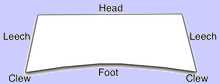 W: The lower corner(s) of a sail to which a
sheet is attached for trimming the sail
(adjusting its position relative to the wind); the metal loop or cringle in the corner of the sail,
to which the sheet is attached. On a triangular sail, the clew is the trailing corner relative to
the wind direction.
W: The lower corner(s) of a sail to which a
sheet is attached for trimming the sail
(adjusting its position relative to the wind); the metal loop or cringle in the corner of the sail,
to which the sheet is attached. On a triangular sail, the clew is the trailing corner relative to
the wind direction.
The appointment of Commodore dates to the mid-17th century: it was first used in the time of William III. There was a need for officers to command squadrons, but it was not deemed desirable to create new admirals (as Post-Captains were promoted to Rear-Admiral in order of seniority). Captains assigned squadron command were given the title of Commodore, but it was not an actual rank. The officer so designated kept his place on the list of Captains. In 1748 it was established that Captains serving as Commodores were equal to Brigadier-Generals in the Army.
Commodores could revert to the rank of Captain at the end of their posting (and Captains could be promoted directly to Rear-Admiral without ever having served as a Commodore).
The Royal Navy Commodore was eventually split into two classes. Those of the first class had a Captain under them to command their ship and were allocated one-eighth of all prize money earned by ships under their command. Those of the second class commanded their own ship as well as the squadron. In 1783, Commodores of the first class were allowed to wear the uniform of a Rear-Admiral, a distinction which continued with some variation until the two classes of Commodore were consolidated in 1958.
(Webmaster's note: In the logbook of the Assistant, the Armed Tender which accompanied Bligh in the Providence on the second breadfruit expedition, both he and his ship are often referred to as 'the Commodore.')
 B Home Glossary D